Mechanical response characteristics and key technology of construction control of roof of long span string beam structure
Summary
This article examines the mechanical response characteristics and construction control technologies of large-span beam string structures (BSS), highlighting innovations and practical applications from the Lingshui Gymnasium project.
Why It Matters
Understanding the mechanical behavior and construction techniques of large-span BSS is crucial for advancing engineering practices in civil construction. The insights provided can enhance safety, efficiency, and innovation in the design and execution of complex structures, which are increasingly relevant in modern architecture.
Key Takeaways
- Large-span BSS structures offer advantages like stability and adaptability but face challenges in loading behavior and deformation control.
- Innovations in construction technology, including improved tensioning methods, enhance the safety and performance of BSS.
- The study's findings from the Lingshui Gymnasium project provide valuable insights for future applications in similar large-span constructions.
- The maximum deflection observed meets serviceability requirements, demonstrating effective design and construction practices.
- Understanding mechanical responses under various loads is essential for ensuring structural integrity and safety throughout the construction process.
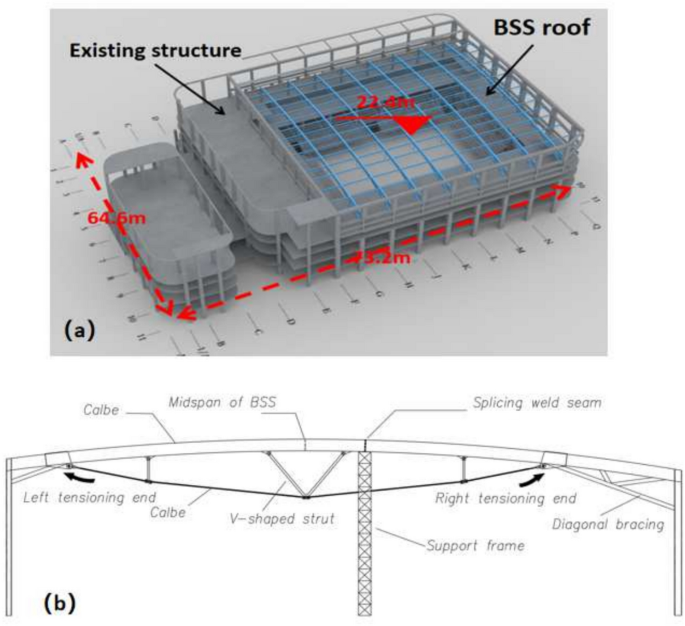
Download PDF Subjects Civil engineeringEngineering AbstractThe high-altitude assembly and tensioning construction of large-span beam string structures (BSS) offers numerous advantages, including structural simplicity, clear force transmission, minimal deformation, strong stability, structural adaptability, self-balancing capability, and ease of construction. However, it also presents technical challenges such as complex loading behavior, difficult deformation control, and high precision requirements during construction. This paper, based on the practical application in the Lingshui Gymnasium project in Hainan, employs a combination of theoretical analysis, numerical calculation, and in-situ testing to investigate the mechanical response characteristics of large-span BSS roofs. Under self-weight, the displacement of the support scaffolding causes the mid-span deflection on the left side of the beam-string to be greater than that on the right side. After the staged tensioning is completed, the mid-span of the beam-string exhibits an upward arching phenomenon. Under the standard combination of dead load and live load, the maximum deflection occurs at the mid-span of the beam-string, with a deflection-to-span ratio of 1/423, which meets the serviceability requirements. In terms of the improvement and innovation of construction technology, the supporting tire frame, tension cable, gusset, early warning and other aspects have been improved and innovated, and these improvements p...